
Aug 16, 2026Furniture Insights
Bathroom Vanity Units: A Sourcing Guide for European Furniture Buyers
Learn how European B2B furniture buyers can evaluate bathroom vanity units, including formats, materials, storage, hardware, packaging and supplier selection.
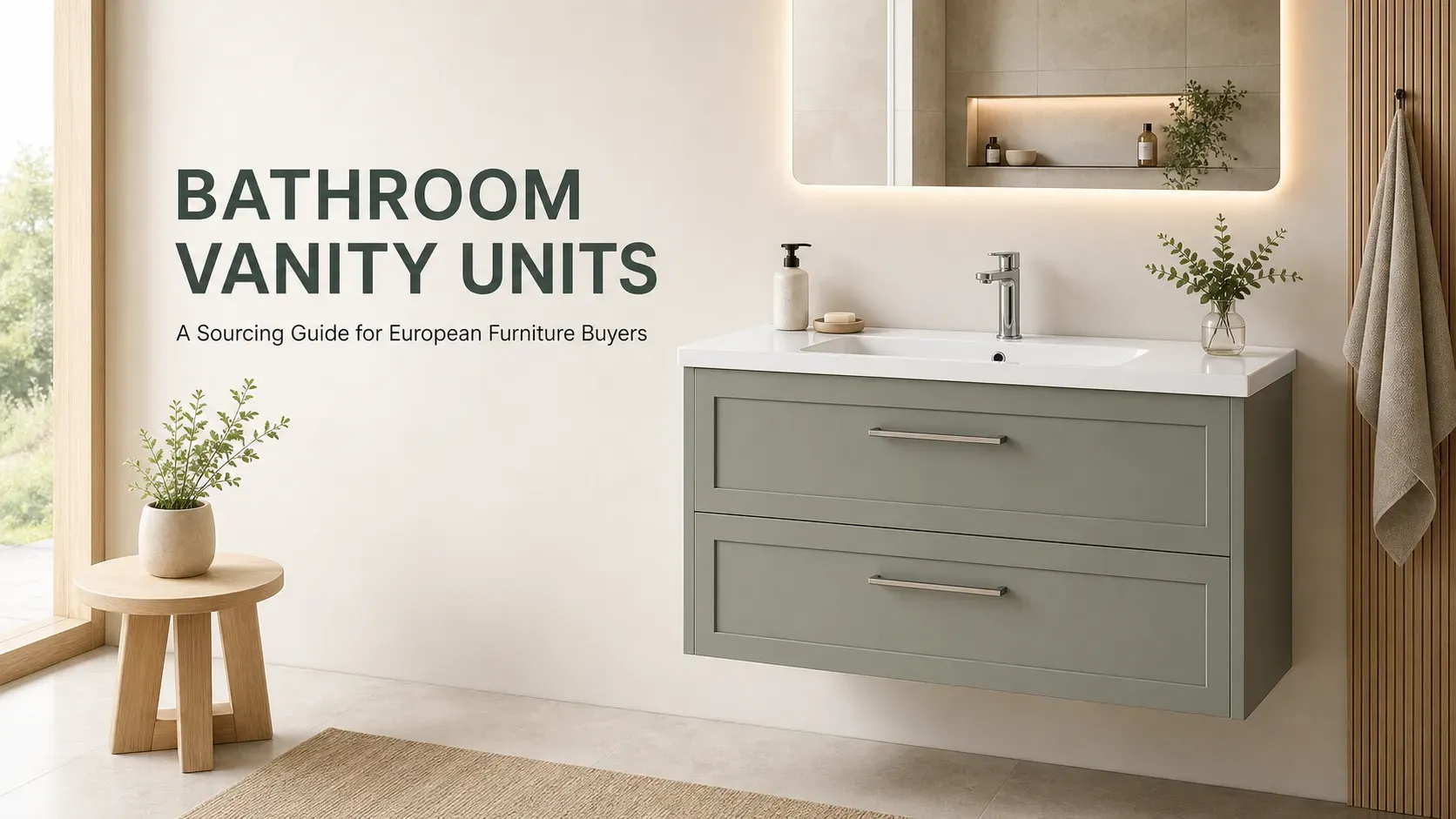
European bathroom furniture buyers need more than an attractive cabinet. A successful vanity unit must combine moisture resistance, practical storage, suitable dimensions, reliable hardware, efficient packaging, and a price point that works in the target retail market.
For importers, wholesalers, retailers, and private label brands, selecting the right bathroom vanity units is therefore both a product decision and a supply-chain decision. This sourcing guide explains the main specifications buyers should evaluate when developing or purchasing bathroom vanity collections for European markets.
1. Understand the European Bathroom Vanity Market
European bathrooms vary considerably by country, property type, and customer segment. However, limited floor space and demand for functional storage influence many purchasing decisions.
Common Market Requirements
Bathroom furniture collections for European homes often need to offer:
- Compact dimensions for apartments and smaller bathrooms
- Practical storage for toiletries and cleaning products
- Contemporary colours that coordinate with multiple interiors
- Easy-to-clean surfaces
- Moisture-resistant materials and finishes
- Flexible wall-mounted or freestanding configurations
- Flat-pack packaging for efficient transportation
- Clear assembly and installation instructions
Importers should also consider whether a collection will be sold through physical stores, specialist bathroom retailers, DIY chains, marketplaces, or direct-to-consumer e-commerce channels. Each sales channel may require different packaging, assembly, photography, product information, and price positioning.
Define the Target Customer Before Sourcing
A vanity designed for an entry-level online range will not have the same specification as one intended for a premium bathroom showroom. Before contacting a manufacturer, buyers should define:
- Target retail price
- Intended sales channel
- Main destination countries
- Preferred design style
- Required cabinet dimensions
- Expected annual order volume
- Packaging and delivery requirements
- Private label or OEM customization needs
A clear commercial brief allows the manufacturer to recommend suitable materials, construction methods, and hardware without pushing the product beyond its target cost.
2. Select the Right Vanity Unit Type
The cabinet format affects installation, storage capacity, packaging, and perceived value. A balanced collection may include several vanity types to serve different bathroom sizes and customer preferences.
Freestanding Vanity Units
Freestanding models are supported by legs, a plinth, or cabinet side panels. They provide a familiar furniture appearance and may be easier for some customers to install.
Their advantages include:
- Strong visual presence
- Practical floor-level storage
- Compatibility with traditional and modern collections
- Reduced dependence on wall structure
- Opportunities to use decorative legs or plinths
Buyers should confirm that the base construction is protected against occasional contact with water.
Wall-Mounted Vanity Units
Wall-mounted vanities create a clean, modern appearance and make the bathroom floor easier to clean. They are particularly relevant to contemporary European collections.
Important sourcing considerations include:
- Cabinet weight
- Wall-fixing method
- Supplied mounting hardware
- Load capacity
- Installation instructions
- Drawer clearance around plumbing
- Compatibility with common European wall types
The manufacturer should clearly define which mounting components are included and which must be selected by the installer.
Single- and Double-Basin Vanities
Single-basin units are suitable for compact and standard bathrooms, while double-basin models generally target larger family bathrooms and higher price segments.
A coordinated collection could include:
- 400–500 mm compact vanity units
- 600 mm core-size vanity units
- 750–800 mm medium vanity units
- 900–1,000 mm large vanity units
- 1,200 mm double-basin vanity units
These dimensions are typical planning references rather than universal standards. Buyers should verify the exact requirements of their destination markets and selected basin suppliers.
3. Evaluate Cabinet Materials and Finishes
Material selection influences appearance, durability, production cost, and suitability for bathroom use.
Painted MDF
Painted MDF is widely used for bathroom furniture because it offers a smooth surface and considerable design flexibility. It is particularly suitable for routed fronts, shaped edges, coordinated colour collections, and Scandinavian-inspired furniture.
Potential benefits include:
- Smooth and consistent painted surfaces
- Broad colour selection
- Clean edge finishing
- Compatibility with decorative profiles
- Consistent appearance across a collection
- Flexible matte, satin, or gloss finishes
The term “painted MDF” alone does not guarantee bathroom performance. Buyers should also assess board quality, surface preparation, coating systems, edge coverage, and production consistency.
Melamine-Faced Panels
Melamine-faced panels can support competitive price points and offer a variety of solid-colour or wood-effect surfaces. They are commonly used in value-oriented and high-volume furniture programs.
Buyers should pay particular attention to:
- Edge-banding quality
- Adhesive performance
- Corner finishing
- Consistency between panels
- Protection around drilled areas
- Resistance to moisture penetration at exposed edges
For a deeper material comparison, buyers can consult Painted MDF vs Melamine Furniture.
Finish Quality
The finish should be evaluated under realistic lighting and from multiple angles. Samples should be checked for:
- Colour consistency
- Surface smoothness
- Paint coverage
- Edge sealing
- Dust or particles in the coating
- Orange-peel texture
- Scratches and pressure marks
- Differences between production batches
When colour matching is important, the approved reference, gloss level, tolerance, and inspection method should be documented before mass production.
4. Compare Storage Configurations
Bathroom vanity storage should be designed around daily use, basin depth, plumbing, and the dimensions of common bathroom products.
Doors and Shelves
Door cabinets offer flexible internal space and can accommodate adjustable shelves. They are suitable for cost-sensitive collections and traditional furniture formats.
Buyers should confirm:
- Shelf thickness and load capacity
- Number of shelf positions
- Hinge opening angle
- Soft-close requirements
- Internal plumbing clearance
- Handle or handleless opening method
Drawers
Drawers improve access to stored items and can support a more premium market position. However, the internal construction must allow for the basin waste and water connections.
Common options include:
- Full-width drawers with plumbing cut-outs
- Split internal drawers
- U-shaped upper drawers
- One deep drawer
- Two-drawer configurations
- Drawer-and-door combinations
Drawer systems should be tested with the expected load. Buyers should also confirm extension length, soft-close performance, lateral stability, and adjustment options.
Open Storage
Open shelves can make a vanity appear lighter and support contemporary or Scandinavian styling. They also create space for baskets, folded towels, or frequently used items.
Because open compartments remain visible, colour consistency and internal finishing become especially important.
5. Coordinate the Cabinet, Basin, and Plumbing
A bathroom vanity is part of a system. The cabinet cannot be evaluated independently from the basin, worktop, waste outlet, and plumbing connections.
Basin Compatibility
Before approving a design, the buyer and manufacturer should confirm:
- Basin type
- Basin dimensions
- Basin weight
- Tap-hole position
- Waste-outlet position
- Overflow requirements
- Worktop cut-out dimensions
- Sealing and installation method
- Required clearances inside the cabinet
If the basin is sourced separately, both suppliers should work from the same approved technical drawings.
Common Product Configurations
Configuration | Typical Positioning | Main Sourcing Consideration |
|---|---|---|
Integrated basin and top | Convenient complete package | Protecting the basin during transportation |
Countertop basin | Contemporary and design-led | Worktop strength, cut-outs, and tap position |
Inset basin | Clean, coordinated appearance | Accurate machining and reliable sealing |
Cabinet supplied without basin | Flexible retailer assortment | Clear compatibility specifications |
Double-basin vanity | Larger or premium bathrooms | Weight, plumbing space, and cabinet rigidity |
Plumbing Access
Poorly planned plumbing clearance can make an attractive vanity difficult to install. Technical drawings should show the usable internal space and the location of drawers, shelves, back panels, and support rails.
Removable or adjustable internal components can increase installation flexibility, but they must not compromise structural strength.
6. Inspect Hardware and Construction Details
Hardware performance has a direct effect on customer satisfaction, return rates, and the perceived quality of the finished product.
Hinges and Drawer Runners
Buyers should specify whether the collection requires:
- Standard-close or soft-close hinges
- Standard or concealed drawer runners
- Partial or full drawer extension
- Adjustable hinges
- Adjustable drawer fronts
- Tested opening and closing cycles
- Corrosion-resistant hardware
Hardware requirements should be recorded in the product specification instead of being agreed only through sample appearance.
Handles and Opening Systems
Handles contribute to both design identity and packaging complexity. Options include:
- Metal bar handles
- Knobs
- Integrated finger pulls
- Routed handle profiles
- Push-to-open systems
- Handleless recessed rails
Buyers should consider replacement availability, finish consistency, corrosion performance, protrusion during transport, and ease of installation.
Structural Details
A production sample should be inspected for:
- Cabinet stability
- Panel alignment
- Secure connections
- Consistent door gaps
- Drawer-front alignment
- Reinforcement around wall fixings
- Back-panel construction
- Worktop support
- Leg or plinth strength
- Accessible assembly points
A vanity may look correct when empty but behave differently after the basin is installed and the storage compartments are loaded.
7. Plan a Commercially Balanced Collection
A strong wholesale collection does not require a large number of unrelated models. It needs a clear product architecture that gives customers useful choices while controlling development and inventory complexity.
Build Around Core Sizes
A practical collection could begin with:
- One compact vanity for small bathrooms
- One core 600 mm model
- One larger family-bathroom model
- One wall-mounted configuration
- One freestanding configuration
- Coordinating tall and wall storage cabinets
Shared components, colours, hardware, and construction details can make the range easier to manufacture and manage.
Develop a Consistent Design Language
Collection consistency can be created through:
- Repeated front profiles
- Matching handles
- Coordinated leg designs
- Shared colour palettes
- Consistent panel thicknesses
- Matching storage furniture
- Related basin and worktop options
Painted MDF enables buyers to develop differentiated colours and front details for private label ranges. Scandinavian-inspired collections may combine simple silhouettes, restrained colours, practical storage, and subtle wood-effect accents.
Buyers exploring coordinated ranges can review JUMA Bathroom Furniture and Painted MDF Furniture.
8. Review Packaging, Assembly, and Quality Control
Packaging is a product-development issue, not merely a shipping task. Bathroom vanities may contain painted panels, mirrors, ceramic basins, hardware, and worktops with different protection requirements.
Flat-Pack and Assembled Supply
Flat-pack bathroom furniture can improve container utilization and reduce logistics costs. It is especially suitable for retailers and e-commerce businesses with established assembly expectations.
Flat-pack products require:
- Accurate panel machining
- Reliable connectors
- Clearly identified components
- Organized hardware packs
- Illustrated assembly instructions
- Suitable corner and surface protection
- Packaging that follows the assembly sequence
Assembled furniture reduces work for the final customer but occupies more shipping volume and still needs protection against impact, vibration, and surface damage.
More information about transport-efficient furniture can be found in JUMA Flat Pack Furniture.
Packaging Review
Before mass production, buyers should evaluate:
- Carton dimensions and gross weight
- Internal component movement
- Protection for painted surfaces
- Edge and corner protection
- Hardware-pack location
- Basin or worktop protection
- Barcode and label placement
- Manual and fitting inclusion
- Handling orientation
- Suitability for parcel or pallet distribution
Quality Control Points
Quality inspections should cover materials, dimensions, appearance, function, packaging, and labeling. A typical control process may include:
- Incoming material inspection
- First-article approval
- In-process dimensional checks
- Surface and colour inspection
- Hardware function testing
- Trial assembly
- Final random inspection
- Packaging verification
- Loading supervision when required
The buyer and manufacturer should agree on approved samples, technical specifications, defect classifications, and inspection criteria before production begins.
9. Choose the Right Bathroom Vanity Unit Supplier
The lowest quotation does not always produce the lowest total sourcing cost. Product failures, unclear specifications, inefficient cartons, late deliveries, and inconsistent finishes can quickly eliminate an initial price advantage.
Supplier Evaluation Checklist
European furniture buyers should assess whether a potential supplier can provide:
- Relevant bathroom furniture experience
- Painted MDF production capabilities
- Stable material and hardware sourcing
- Technical drawing support
- Sample development
- OEM and private label services
- Moisture-conscious construction
- Flat-pack engineering
- Packaging development
- Documented quality control
- Consistent production capacity
- Clear export communication
Information to Include in an RFQ
A useful request for quotation should contain:
- Product drawings or reference images
- Required dimensions
- Material and finish specifications
- Preferred colours
- Basin and worktop requirements
- Hardware expectations
- Packaging format
- Labeling and branding requirements
- Target quantity per model
- Destination market
- Compliance or testing requirements
- Target delivery schedule
Complete information makes quotations easier to compare and reduces the risk of later cost changes.
Working with JUMA Furniture
JUMA Furniture specializes in painted MDF furniture, Scandinavian furniture design, storage solutions, flat-pack furniture, and OEM or private label manufacturing. Bathroom vanity units can be developed as individual products or as part of coordinated bathroom storage collections.
Importers, wholesalers, retailers, and e-commerce brands can work with JUMA on material selection, product dimensions, colours, hardware, construction, packaging, and collection development.
Explore JUMA Bathroom Vanity Units, learn about OEM and Private Label Furniture Manufacturing, or contact JUMA Furniture to discuss a sourcing project.